
内容 隐藏 1 QT10-15 Block Machine for Sale in Iran: Complet […]
QT10-15 Block Machine for Sale in Iran: Complete Production Line Supplier
The biggest mistake in buying a QT10-15 block making machine for Iran isn't choosing the wrong brand, but overlooking the supplier's ability to adapt it to local voltage and aggregate conditions.
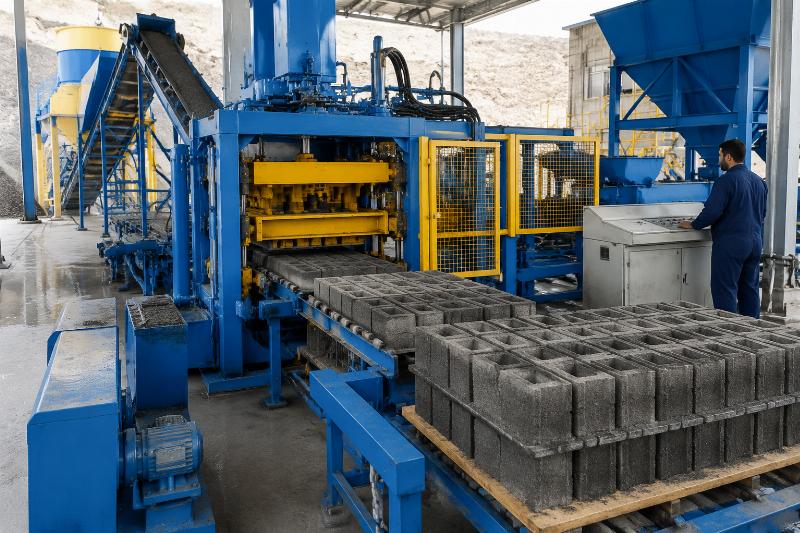
For investors in Iran searching for a "QT10-15 block machine sale" or a "complete block production line," the direct answer is this: A well-configured, locally-adapted QT10-15 automatic line can achieve a return on investment (ROI) typically within 12-18 months, with a daily output of up to 14,400 standard hollow blocks per 8-hour shift. The critical success factor is partnering with a supplier that delivers a true turnkey solution—from site-specific engineering for Iran's 380V grid and local sand/gravel to on-the-ground installation and training—not just selling a standalone machine.
In my 18 years of exporting block production machinery to over 108 countries, I've seen the pattern clearly. The most successful installations in markets like Iran share one common thread: the project was treated as an integrated system, not a product purchase. For instance, we recently commissioned a QT10-15 complete block production line for a contractor outside Tehran. The client's primary intent was securing a line for a large-scale affordable housing project. [The key challenge was not machine availability, but ensuring the entire system—from the twin-shaft mixer's calibration for local aggregate gradation to the PLC's tolerance for voltage fluctuations—was pre-engineered for Iran.] This forethought reduced the commissioning time to just 45 days from contract signing to stable production, directly meeting the project's aggressive timeline.
This experience underscores that your search for a "full automatic brick plant supplier Iran" should focus on systemic solutions. Let's break down the critical questions.
What is the Real ROI of a QT10-15 Production Line in Iran?
Your payback period is less about the machine's sticker price and more about its operational uptime and compatibility with local inputs.
A common miscalculation is focusing solely on the initial quote for the QT10-15 block making machine. The real cost—and thus the real ROI—is determined by daily operational efficiency. A line designed for European stable grids and standardized aggregates will struggle and incur high downtime costs in a different environment. A proper financial model must factor in local cement prices, the cost and characteristics of Iranian sand and gravel, and the expected machine utilization rate.
| Evaluation Factor | Inefficient Approach (High Long-Term Cost) | Recommended Approach (Optimized ROI) |
|---|---|---|
| Cost Calculation Basis | Comparing only the initial QT10-15 block making machine price in Iran from different suppliers. | Modeling total cost per block based on local material costs, expected energy consumption, and a realistic ~85% equipment utilization rate. |
| Technical Design | Assuming a standard machine configuration will work globally. | Insisting on design proof for 380V, 50Hz power with protective systems and mixer settings for regional sand/cement ratios. [Inefficient mixing due to uncalibrated systems can increase cement consumption by 5-10%, directly eroding margins.][^1] |
| Supplier Value Proposition | Choosing the lowest bidder. | Selecting a partner who provides a complete ROI analysis based on your local conditions, not just a equipment catalog. |
Consider the case of an entrepreneur in Isfahan. He operated a semi-automatic QT6-15 line and sought to upgrade for a major contract. His core intent was to increase output without a complete factory overhaul. We provided a seamless upgrade path to a QT10-15 complete block production line, reusing some existing infrastructure. The new line's capacity increased by roughly 150%, and the investment for the upgrade was recovered in approximately 14 months. The pivotal factor wasn't just the faster cycle time of the new host machine, but the integrated design that prevented bottlenecks in mixing and conveying, maximizing the host's utilization.
To accurately gauge your potential ROI, follow this actionable list:
- Demand Localized Cost Models – Require suppliers to provide a block cost calculation using current Iranian cement and aggregate prices from your region.
- Audit Operational Efficiency – Evaluate the proposed line's theoretical output against its practical output, factoring in local 8-hour shift patterns and maintenance windows.
- Calculate Total Cost of Ownership – Include the cost of potential add-ons like voltage stabilizers or dust protection, which are not optional for stable long-term operation in Iran.
How to Tell If a Supplier Is an "Experienced Partner" or Just a "Paper Seller"?
The difference lies in their portfolio of de-identified case studies, not their brochure's page count.
When evaluating a full automatic brick plant supplier Iran, their marketing claims are irrelevant. What matters is documented, applicable experience. A credible supplier can immediately discuss solutions for Iran-specific challenges: voltage sags, fine desert sand, coarse mountain gravel, and the logistical nuances of shipping to Bandar Abbas port. They should speak in terms of solutions, not just specs.
| Supplier Capability | "Paper Seller" Indicator (High Risk) | "Experienced Partner" Indicator (High Reliability) |
|---|---|---|
| Localization Evidence | Vague statements like "our machines work worldwide." | Provides detailed, de-identified case studies (e.g., "Project for a Tehran housing contractor, 2023") with specs adapted for local conditions. |
| Technical Support | Promises "remote online support" as the primary solution. | Maintains a network of trained local engineers or partners in the MENA region and commits to on-site commissioning and training. |
| Compliance & Certification | Offers only a self-declared certificate. | Provides internationally recognized certifications like CE (Machinery Directive) and ISO 9001, which are often required for serious tenders and ensure a baseline of safety and quality control. [CE certification involves rigorous assessment of safety risks, a process unfamiliar to non-specialized manufacturers.][^2] |
Take our engagement with an Iranian equipment distributor. Their intent was to become a regional leader, requiring a competitive edge in both price and technical support for bids. Beyond offering competitive container-level pricing for the QT10-15 block machine sale, we provided OEM branding options and, crucially, comprehensive training for their local engineers. This empowered them to offer superior after-sales service, turning our product into their competitive advantage. This deep partnership is only possible with a manufacturer that has institutionalized knowledge transfer.
Use this 5-point audit list to vet potential suppliers:
- Localized Case Library – Request 2-3 specific project summaries for the MENA region, with technical adaptations described.
- Spare Parts Logistics – Confirm the location of spare parts warehouses and average delivery timeframes to Iran.
- Structured Training – Review the curriculum for on-site operator and maintenance training.
- Certification Portfolio – Verify authentic CE and ISO certificates with audit trails.
- Energy & Durability Design – Ask for specific design features that protect against voltage fluctuation and dusty environments.
What Are the Critical Steps and Hidden Pitfalls from Contract to Stable Production?
A true turnkey project has a defined, accountable timeline for each phase; a mere equipment sale leaves you to manage the chaotic middle.
The journey from signing a contract for a QT10-15 complete block production line to producing sellable blocks is fraught with potential delays. The most common pitfall is the "missing link"—where the supplier's responsibility ends at the port, leaving you to handle customs, foundation design, installation, and calibration. Each of these unsupervised steps can add weeks or months of delay, crippling your ROI calculation.
| Project Phase | Pitfall (Causing Delay/Cost Overrun) | Professional Turnkey Practice (Ensuring Predictability) |
|---|---|---|
| Pre-Shipment | Supplier provides generic foundation drawings. | Supplier conducts a site audit (virtual or in-person) to provide customized layout and foundation plans based on your site's specifics. |
| Shipping & Logistics | You are responsible for customs clearance and inland transport. | Supplier offers CIF/CIP terms and assists with customs documentation, or partners with a reliable freight forwarder familiar with Iranian imports. |
| Installation & Commissioning | Machine arrives with an unclear manual; you find local technicians. | Supplier's engineers travel to your site for supervised installation, mechanical/electrical connection, and production commissioning until first pallets of qualified blocks are produced. [Unsupervised installation is a leading cause of premature wear and failure, as improper leveling or alignment stresses core components.][^3] |
For example, in the Tehran housing project mentioned earlier, the 45-day timeline was achieved because it was managed as a single-point-responsibility turnkey project. Our team handled the modularized packing for efficient unloading, provided precise foundation drawings, and our engineers were on site to orchestrate assembly and calibrate the PLC for the specific mix design. This eliminated the typical trial-and-error period that follows a DIY installation.
To avoid costly pitfalls, ensure your contract mandates this sequence:
- Site-Specific Layout Design – Finalized before manufacturing begins.
- Modularized Shipping & Documentation – Clear packing lists and customs documents (like the packing list, commercial invoice, and certificate of origin) provided proactively.
- Supervised Installation & Wet Commissioning – Engineers present to install, wire, test with water, and finally run production with actual materials.
- Structured Handover Training – Formal training for operators, maintenance staff, and a supervisor on both routine operations and basic troubleshooting.
Beyond the Host Machine, Which Auxiliary Equipment Dictates Line Efficiency?
The QT10-15 block making machine is the heart of your line, but the supporting systems—mixing, conveying, stacking—are the circulatory system that determines its health and output.
Focusing solely on the host machine's cycle time is a critical error. You could have a machine capable of a 15-second cycle, but if the mixer cannot supply consistent batter in time or the stacker cannot clear pallets fast enough, your actual output plummets. The synergy of the entire system is what delivers the promised daily output of 14,400+ blocks.
| Auxiliary System | Impact of a Sub-Optimal Choice | Contribution of a Synergistic Design |
|---|---|---|
| Mixing & Batching System | Inconsistent water/cement ratio leads to block strength variations and high rejection rates. A slow batch cycle creates idle time for the host machine. | A twin-shaft mixer with precise weigh-batching ensures homogeneous mix for every cycle, directly determining final product quality and minimizing waste. |
| Pallet Circulation & Conveying | Manual pallet return or misaligned conveyors become major bottlenecks, limiting output to 40-50% of theoretical capacity. | A closed-loop, synchronized pallet circulation system keeps the host machine running non-stop, unlocking its full potential. |
| Automatic Stacking & Curing | Manual stacking is labor-intensive, slow, and increases product damage rates significantly. | An automatic stacker with programmable patterns handles output gently, feeds the curing rack system efficiently, and reduces labor costs by approximately 60-70%. |
This principle was key for a distributor client who needed to offer a competitive full automatic brick plant supplier Iran package. We didn't just offer them a QT10-15 machine. We provided a coherent system: the twin-shaft mixer was sized for the machine's consumption rate, the belt conveyors were designed for the weight and abrasiveness of Iranian aggregates, and the stacker's speed matched the production cycle. This integrated design meant their clients achieved high utilization rates from day one, with product consistency that secured repeat orders.
When planning your line, insist on a holistic review of these three auxiliary systems:
- Mixer Batch Cycle Time – Must be equal to or less than the host machine's cycle time to prevent waiting.
- Conveyor System Synchronization – All transfer points must be timed to avoid block damage or jams.
- Stacker Capacity & Pattern Flexibility – Must handle peak output and adapt to different block types (solid, hollow, interlocking).
Conclusion
Ultimately, procuring a QT10-15 block machine for sale in Iran is an investment in a production system, not just a piece of equipment. The fastest ROI is achieved by prioritizing suppliers with demonstrable, localized experience who deliver complete, turnkey solutions engineered for Iran's unique operational landscape. Your due diligence should shift from comparing basic machine prices to auditing suppliers on their integration capability, their adaptation evidence for local conditions, and their commitment to a seamless journey from contract to consistent, profitable production.
[^1]: Cement Consumption in Concrete and Mortar — National Ready Mixed Concrete Association (NRMCA) — https://www.nrmca.org/about-concrete/cement-consumption/ [^2]: EU Machinery Directive 2006/42/CE — Official Journal of the European Union — https://eur-lex.europa.eu/LexUriServ/LexUriServ.do?uri=OJ:L:2006:157:0001:0042:EN:PDF [^3]: Installation, Operation and Maintenance Manual — Columbia Machine — https://www.columbiamachine.com/sites/default/files/Installation%20Manual%20IM-1000-EN.pdf


发表回复