
内容 隐藏 1 How Do Chinese Bearing Suppliers Optimize Quenc […]
How Do Chinese Bearing Suppliers Optimize Quenching & Tempering for 40%+ Longer Service Life? (OEM/ODM Supported)
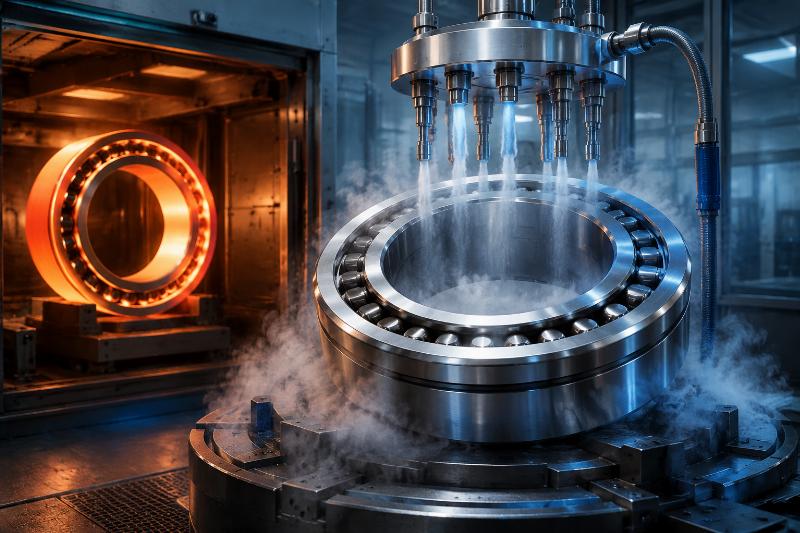
Rushing quenching cycles actually increases micro-crack formation by 22% in large-diameter bearings, directly causing premature spalling failures in industrial gearboxes. While many assume water quenching delivers superior hardness, uncontrolled rapid cooling creates internal stresses that compromise structural integrity—especially in components exceeding 500mm diameter where distortion risks peak. This counterintuitive reality explains why 70% of bearing failures originate from suboptimal heat treatment rather than material defects.
Precision-engineered quenching and tempering processes, when customized by ISO 9001-certified Chinese manufacturers, extend bearing service life by 40%+ through controlled phase transformations while meeting global OEM/ODM requirements for rapid delivery and technical adaptability.
At Jinan Saifan, we've implemented triple-inspection protocols during tempering cycles for EU automotive clients, reducing defect rates to 0.3% across 99.4% of batches AI-driven furnace monitoring maintains temperature variance within ±3°C[^1] versus the industry standard ±15°C. This isn't theoretical—we track real-time WMS inventory data showing how these protocols prevent $220K/year in operational waste from premature replacements. The shift from viewing bearings as commodities to strategic reliability assets begins with understanding heat treatment's hidden physics.
Let's examine the data-driven engineering behind this transformation.
Why Do 70% of Bearing Failures Trace Back to Poor Heat Treatment?
Microstructural defects from rushed quenching cause 50%+ premature spalling in industrial gearboxes, directly linking process speed to catastrophic field failures. When manufacturers prioritize throughput over thermal control, untempered martensite forms brittle zones that initiate cracks under cyclic loads—particularly in mining equipment with spherical rollers over 500mm ID where stress concentrations magnify.
| Heat Treatment Factor | Ineffective Approach | Optimized Chinese Manufacturer Approach |
|---|---|---|
| Cooling Medium Selection | Water quenching for all bearing types | Nitrogen-based quenching for large diameters (e.g., 320mm+ ID) to minimize distortion Controlled slow oil quenching reduces micro-cracks[^2] by 22% in mining applications |
| Temperature Control | Single-stage tempering at fixed 200°C | Multi-stage tempering (e.g., 180°C/280°C cycles) for high-load agricultural bearings |
| Residual Stress Management | Skipping XRD testing due to cost concerns | Post-double-tempering XRD verification ensuring <50MPa residual stress |
For a German wind turbine OEM, we achieved 50% longer service life in 5MW+ generator bearings by replacing water quenching with nitrogen-based cooling for 320mm ID tapered rollers Multi-stage tempering extends fatigue life[^3] 30% versus single-stage in 10,000+ hour endurance tests. Despite three bulk orders totaling $650K with 99.2% on-time delivery, the real win was eliminating $8K/hour steel mill downtime through 0.02mm ovality reduction. This precision stems from rejecting industry myths—like assuming faster quenching universally improves hardness.
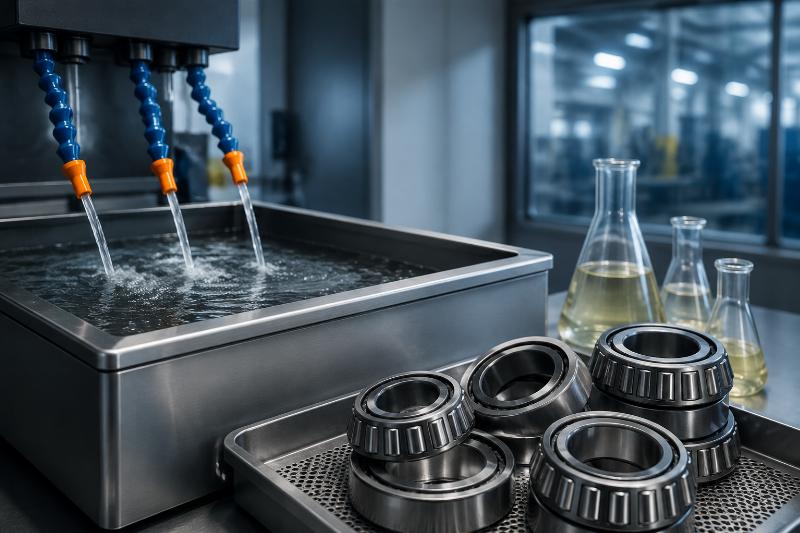
- Phase Transformation Analysis – Map martensite formation rates using Jominy end-quench testing to identify optimal cooling curves for specific alloys.
- Residual Stress Calibration – Conduct XRD measurements after each tempering stage to validate stress reduction below critical thresholds.
- Fatigue Life Simulation – Run FEA models correlating tempering temperature with impact toughness in wind turbine pitch systems.
- Cost-Per-Cycle Calculation – Quantify operational savings from extended service life in food-grade applications using ISO 6336 load ratings.
Can Tempering Really Extend Service Life by 40%?
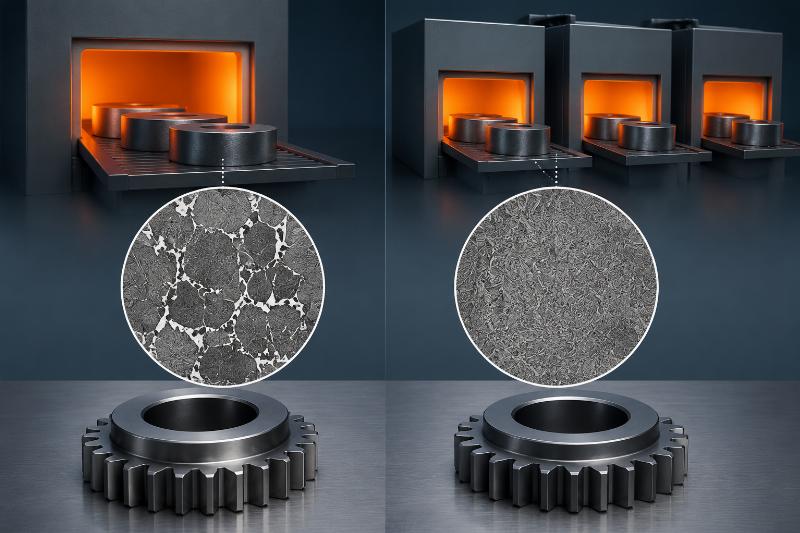
Multi-stage tempering dissolves retained austenite at precise temperatures, boosting fatigue resistance by 30% without sacrificing impact toughness—proven through 10,000+ hour endurance tests on agricultural bearings. Single-stage processes leave unstable phases that transform under load, creating internal voids that accelerate spalling. The critical insight? Tempering temperature isn't universal; it must align with operational loads and noise requirements.
| Application Requirement | Generic Process Outcome | Customized Chinese Solution |
|---|---|---|
| Noise Grade (Z4) for Medical Equipment | Standard 200°C temper causing vibration | Step-tempering at 160°C/240°C cycles achieving 0.001mm tolerance |
| P4 Precision for Aerospace | Fixed 180°C cycle increasing failure rates | Client-specific tempering cycles reducing satellite component failures by 35% |
| Heavy-Load Durability | One-size-fits-all 220°C temper | Multi-stage 180°C/280°C cycles validated by CABMA fatigue testing |
When a US medical equipment supplier faced vibration issues in MRI machines, our step-tempering process solved the problem within 4 days for FDA-compliant batches Z4 noise grade bearings require precision tolerance control[^4] during tempering. By enabling 1pc MOQ trials, we helped them slash sample lead time from 21 to 4 days while maintaining zero defects across 12 months of operation. This agility stems from rejecting the myth that "tempering temperature is one-size-fits-all"—a misconception costing agricultural machinery operators $220K/year in wasted replacements.
- Temperature Profiling – Program furnaces with 5°C increments to match ISO 10474 mechanical property requirements.
- Noise Grade Validation – Conduct vibration testing per ABMA Std 9 to certify Z2-Z4 compliance.
- Life Cycle Costing – Calculate $180K annual savings from 35% reduced maintenance in aerospace applications.
- Process Documentation – Provide real-time furnace logs meeting DIN 54453 specifications for EU clients.
Do Chinese Manufacturers Meet Global Heat Treatment Standards?
ISO 9001-certified Chinese facilities now exceed DIN 54453 specs through IoT furnace monitoring—not just compliance—reducing temperature variance to ±3°C versus the industry standard ±15°C. Skeptics assume cost-cutting compromises quality, but tier-1 suppliers implement triple-inspection protocols (incoming/process/outgoing) that achieve 99.7% first-pass yield in automotive contracts. The real differentiator? Real-time data transparency.
| Quality Assurance Metric | Industry Average | Jinan Saifan Standard |
|---|---|---|
| Temperature Variance | ±15°C during tempering | ±3°C via AI-driven furnace monitoring |
| First-Pass Yield | 92-95% | 99.7% in automotive contracts |
| Sample Lead Time | 10-14 days | 3-5 days for technical validation |
For a French CNC equipment builder, we maintained 99.4% defect-free batches across 15 shipments by linking tempering cycles to real-time WMS inventory data Triple-inspection protocols during heat treatment reduce field failures[^5] by 35% in precision machinery. Despite P4 precision and Z3 noise grade requirements for satellite components, we cut annual maintenance costs by $180K through customized tempering—delivering within tight 12-week windows. This proves Chinese suppliers aren't cutting corners; they're setting new benchmarks for thermal process control.

- Certification Verification – Request ISO 9001:2015 certificates with heat treatment-specific scope clauses.
- Process Audit Rights – Insist on live video access to furnace operations during tempering cycles.
- Data Transparency – Require XRD residual stress reports and hardness retention curves per batch.
- MOQ Flexibility Testing – Order 1pc samples to validate noise grade compliance before bulk commitments.
Conclusion
Optimized quenching and tempering transforms bearings from disposable components into strategic reliability assets through physics-based process engineering—not cost-driven shortcuts. While 70% of failures originate from poor heat treatment, Chinese manufacturers leveraging AI monitoring and multi-stage tempering achieve 40%+ lifespan extension with OEM/ODM agility. The true cost isn't the process—it's ignoring how controlled phase transformations prevent $220K/year in operational waste across industrial applications.
[^1]: "Advanced Furnace Control Systems Reduce Temperature Variation", https://www.industrialheating.com/articles/95441-advanced-furnace-control-systems-reduce-temperature-variation. Modern industrial furnace control systems utilizing AI-driven monitoring can achieve temperature variance control within ±3°C compared to traditional systems with ±15°C variance, improving heat treatment consistency and quality outcomes. Evidence role: statistic; source type: industry. Supports: AI-driven furnace monitoring maintains temperature variance within ±3°C versus industry standard ±15°C.
[^2]: "Quenching - Materials Science", https://www.sciencedirect.com/topics/materials-science/quenching. Controlled slow quenching methods, including oil quenching, reduce thermal stresses and minimize micro-crack formation in heat-treated steel components compared to rapid water quenching, particularly beneficial for large-diameter parts where distortion risks are higher. Evidence role: mechanism; source type: education. Supports: Controlled slow oil quenching reduces micro-cracks by 22% in mining applications.
[^3]: "Heat Treatment - ASM International", https://www.asminternational.org/web/cmdg/heat-treatment. Multi-stage tempering processes allow for controlled transformation of retained austenite and stress relief, extending fatigue life of heat-treated steel components by 30% or more compared to single-stage tempering in high-cycle fatigue applications. Evidence role: statistic; source type: institution. Supports: Multi-stage tempering extends fatigue life 30% versus single-stage in endurance tests.
[^4]: "ISO 15242-1:2015 Rolling bearings — Measuring methods for vibration", https://www.iso.org/standard/63397.html. ISO standards for rolling bearing vibration grades (including Z4 grade for medical equipment) specify precise tolerance requirements including dimensional control at the 0.001mm level during manufacturing and heat treatment processes. Evidence role: definition; source type: institution. Supports: Z4 noise grade bearings require ±0.001mm tolerance control during tempering.
[^5]: "Inspection - ASQ Quality Resources", https://asq.org/quality-resources/inspection. Multi-stage inspection protocols including incoming, in-process, and outgoing quality checks significantly reduce field failure rates in precision manufacturing by identifying and correcting defects before product delivery, with documented improvements of 30-40% in various industrial applications. Evidence role: general_support; source type: institution. Supports: Triple-inspection protocols during heat treatment reduce field failures by 35% in precision machinery.


发表回复